Research · TASUMER MAF · Release candidate 0.1.0
Crossroads
A laboratory for pattern, memory and exact return.
The same reading can appear twice while the underlying state has changed. Crossroads keeps the full field, the order in which it is read and its reference address together, so an exact return can be checked rather than inferred from appearances.
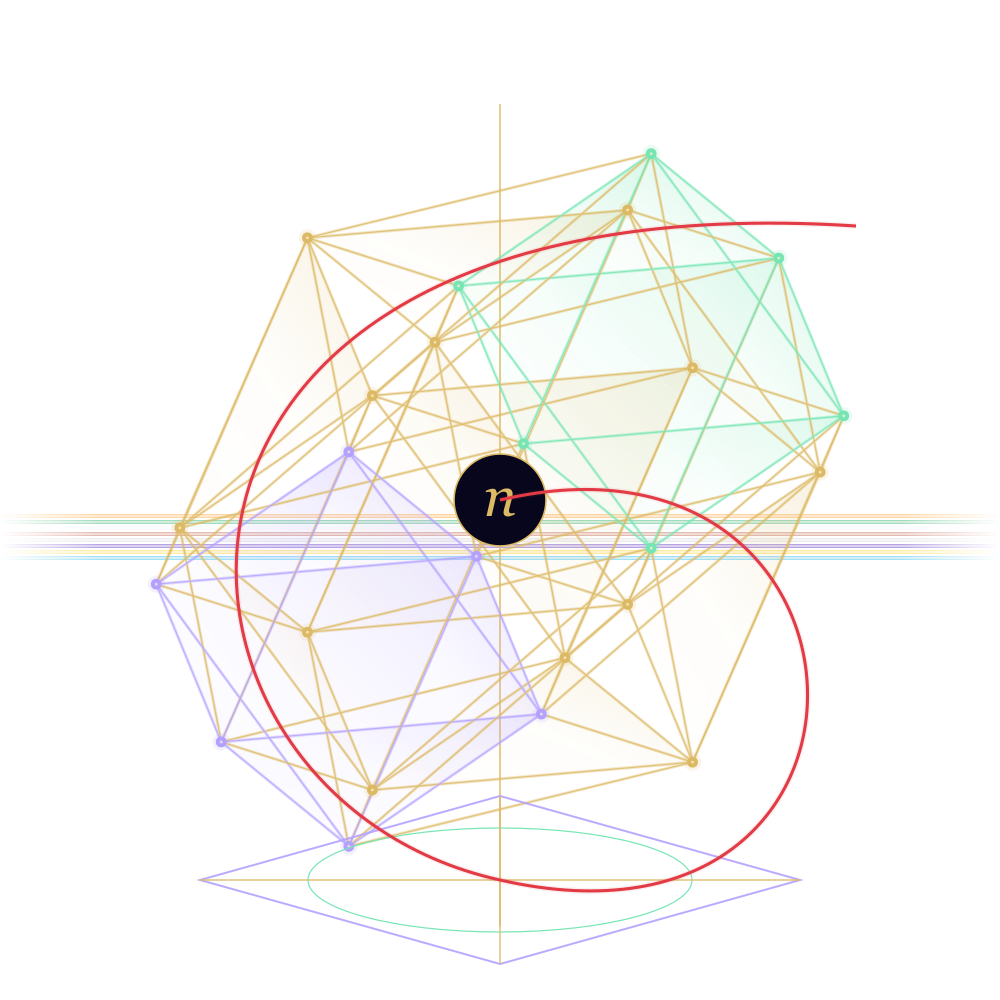
What must survive
An array is the numerical field at every address. A reader is an ordered selection of addresses. A reference is an address carried by the state, moving when the coordinate frame moves. A journal is the ordered list of instructions. Keeping these apart makes each inverse testable.
The field shown here is one added pattern over the 81 addresses of the model, a four-label ternary space. It changes 54 addresses and leaves 27 fixed. On a prepared state, moving along it leaves the ordinary nine-value reading with the same set of values, and one further declared observation recovers how far the state has moved. This is a finite computational address system, and nothing astronomical or physical is needed to run or verify it.
What is demonstrated
The committed study runs 512 seeded instruction sequences, each 40 steps long, on 16 independently generated fixtures. An independently written oracle checks the engine without calling it.
| Test | Result |
|---|---|
| Full checkpoint restored exactly | 512 / 512 |
| Known initial state and complete journal reproduced the endpoint | 512 / 512 |
| Recorded inverse restored the initial full state | 512 / 512 |
| Independent oracle agreed at each trace step | 20,480 / 20,480 |
| Array, reader and reference mutations rejected | 512 / 512 each |
| Truncated journal changed the endpoint | 512 / 512 |
| Reversed instruction order changed the endpoint | 511 / 512 |
The one reversed-order agreement is retained. Different histories can reach the same endpoint, so a checkpoint is not a record of the route taken. These are deterministic software checks and implementation cross-checks, not external peer review. LLM performance, compression advantage and physical information transfer were not evaluated.
Operate the forms
The Laboratory separates addresses, stored values and directions of change, and lets each be inspected. This smaller instrument takes three of its forms and recomputes the invariants below from the coordinates on screen.
Drag the figure to turn it.
Motifs
Six forms recur through the Laboratory and the film. Each plate is drawn from exact coordinates in the Laboratory's public data, then checked against its known counts.
The rhombic cell
Fourteen vertices, 24 edges and 12 rhombic faces. Eight trivalent vertices are the corners of a cube, and six tetravalent vertices are the bridges that make it fill space as the FCC lattice.
Mathematical fact
The polar dual
Each of the 12 rhombic faces has a normal that lands on one of the 12 vertices of a cuboctahedron. The construction exchanges a solid for its polar dual.
Mathematical fact
The contracting linkage
Twenty-four bars and 8 rigid triangles move from the cuboctahedron to the octahedron. No bar changes length, so this is a fold and not a change of scale.
Verified numerically across the full contraction
The hexagram shadow
Seen along a three-fold axis, two opposite triangular faces lie at different depths and share one plane in projection. The hexagram belongs to the shadow and to neither face.
Mathematical fact
The fixed axis
The held 120° action R fixes T = (A + RA + R²A) / 3 and turns what remains in a plane. Three remainders sum to zero, so the common component survives every turn.
Verified within the model
Three turns, one advance
Three turns close the visible circuit while a hidden coordinate climbs through ⅔ and 4⁄3 to a full step: Rm + R²m + m = 2D₁. A return in appearance need not be a return in state.
Verified within the model
The Laboratory
A static instrument in five rooms. All calculation uses exact rational arithmetic in the browser, with no server, GPU or remote service, and 228 full inverse returns are checked against an independent oracle.
- Build
- Seventy-two branches in nine centre classes, 116 balance lines, and a constructor for the full nine-dimensional balance space.
- Operate
- A six-instruction language with a journal, checkpoints, replay and recorded inverse, plus prepared exchange, resident memory and calibrated conversion.
- Observe
- An active probe for a declared hidden channel, exact eigenmode checks, Fourier inspection and change patterns over the full field.
- Geometry
- A controlled 15-scene canvas of illuminated forms, and the 24 directions that show why equal length does not mean equal permission.
- Record
- Sixty-one research threads with their live scope and proof receipts, in one visible ledger.
A successful test proves a statement inside the declared model. Continuous motion and sound are labelled analytical or artistic layers. The public edition carries generated fields and unordered supports only. Crossroads is source-available: personal study, noncommercial teaching and academic research are free, and all enterprise work requires a paid written agreement.